



The NCAA finalized a change to the transfer portal Tuesday that may make waves in the coming offseason. College football is officially ditching its dual-portal system and adopting a single winter window from Jan. 2–16.
The transfer system has undergone many changes in recent years, from the creation of the online portal, the limitation on the number of transfers and even the reversal of that decision. Mix in NIL payments, along with the recent house settlement, and you get a college football ecosystem that is chaotic, to say the least.
However, this most recent change may be the response college football was looking for.
Brad Corbin, deputy director of Athletics for WSU, is a member of the Division I Council, which manages the day-to-day decisions of the NCAA. He voted on the decision to move to the single portal and has been part of the conversation for quite some time.
“The FBS Oversight Committee has been talking about this for a little while,” Corbin said. “We’re experiencing a really large amount of roster instability. People don’t know who is on the team, who’s coming, who’s going.”
For Corbin, roster instability makes team chemistry hard to build.
“If you’re trying to build a team that’s cohesive, that the players can get to know one another…and take their skills and their practice reps into next season…you need to be looking at it from ‘okay let’s do all the transferring and then let’s look at the next season’,” he said.
According to Corbin, the new portal’s overall benefit to college football is simple.
“I think it’s roster stability,” he said. “You’re going to know who your teammates are. The coaches know who they’re trying to build up, who’s bought in, who wants to be there, who wants to look toward that next season.”
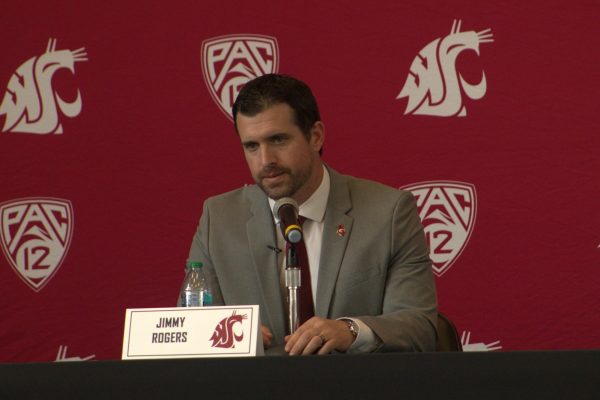
Jimmy Rogers speaks at his introductory press conference Jan. 9 2025.
The decision was not unilateral. The NCAA relied heavily on student-athlete feedback to guide its decision, attempting to balance student and program needs.
“The student-athletes are looking at it from the standpoint of they understand we need to get some stability there,” Corbin said. “At the same time, they want it to be an ample opportunity. We’re looking at it from the standpoint of, what provides that opportunity for people…while also balancing the interests of the program.”
A voice that may get drowned out in the conversation are students who stay with their schools. Corbin said their experiences did not go unnoticed.
“We also think about this for the student athletes that remain,” he said. “If I know I want to stay at WSU, do I want to spend the entire spring going, ‘Who’s coming? Who’s going? Who is my teammate? Who’s going to be here next year?’…there’s stability on both sides that needs to be discussed.”
That stability is something yet to be seen, which head coach Jimmy Rogers realizes.
“We’ll find out,” Rogers said. “The reality is I think it is a step in the right direction.”
Coming into his first year with WSU, Rogers is put into a unique situation with this recent change. As someone who experienced the portal firsthand, Rogers is curious to see how the new system works out.
“It’s unknown, so we’ll see what it’s like,” he said. “How many will go into just this one window? Will they all feel like they can find a home or not? Maybe it slows it down? I don’t know. We’ll just have to wait and see what type of players go into that portal.”
It is not just Rogers who worries for those in the portal, as WSU quarterback Zevi Eckhaus voiced his concern.
“A lot of guys are going into it, and unfortunately a lot of guys are getting stuck in it,” Eckhaus said. “Whatever way the NCAA can benefit the kids finding schools and finding homes that can help them play the sport they love I think is beneficial.”
Eckhaus is more than familiar with the dual-portal system, which he realizes puts quite a bit of strain on young athletes.
“It’s hard cause you get a bunch of new teammates and maybe they leave,” he said. “You get a guy who comes in kind of late and you got to get them up to speed.”

Quarterback Zevi Eckhaus warms his arm up with practice throws before the Crimson and Gray Showcase on April 12 in Pullman, Wash.
Although Eckhaus admitted to the difficulty roster instability brings, he refused to pass the buck.
“I think it’s the quarterback’s job to get the guy acclimated, make sure he’s up to speed, make sure he knows what’s going on, make sure he feels comfortable,” Eckhaus said. “It’s the quarterback’s job to make them feel welcomed.”
Even with the change, Rogers does not let it cloud his focus on the future.
“You can’t miss in high school recruiting,” he said. “You got to do a good job of recruiting high school players that you feel will have longevity and be able to help you compete…Every player that you bring in you got to make sure you evaluate them. You got to get to know them at a decent level and you got to see if they are the right fit.”
That commitment is a factor Rogers takes seriously when he evaluates recruits.
“Just because they have talent doesn’t always mean that they’re the right fit,” Rogers said. “They may come in and be a great talent but not buy into the program or their role or do the work necessary in order to compete.”
This approach to culture is something that even Corbin can see.
“Coach Rogers has a tremendous history of building a culture that holds onto his players,” he said. “If you look back at South Dakota State, he held onto his student athletes…he is doing a great job of building a really all-in culture.”
With recent changes to the college football environment, Corbin believes this move was the necessary choice.
“The entirety of college athletics has changed,” he said. “The house settlement up-ended what traditional college athletics [is]…we’re trying to blend the student athlete experience with the program experience…I think it is a recognition of the reality of college athletics.”
All in all, the new portal’s impact can be summarized simply.
“Having the ability to retain our team over the course of one transfer portal window and then be able to confidently go to work with that crew. I do think that’s big,” Corbin said.

Josh Meredith and Leo Pulalasi lead out the Cougar football team on Aug. 30 against Idaho.
This new window will not fix every problem with college athletics. As a whole, the college football landscape is characterized by chaos, conference shake-ups, mass transfers, NIL, academic probations and roster uncertainty.
While sports like football and basketball get national media coverage, brand sponsorships and heavy pressure to perform, there is one thing to keep in mind through all of it…these are kids.
These young student athletes can benefit from some stability in an inherently unstable environment. If this single window can make college football more consistent, them Rogers may be correct when he says it is a step in the right direction.