

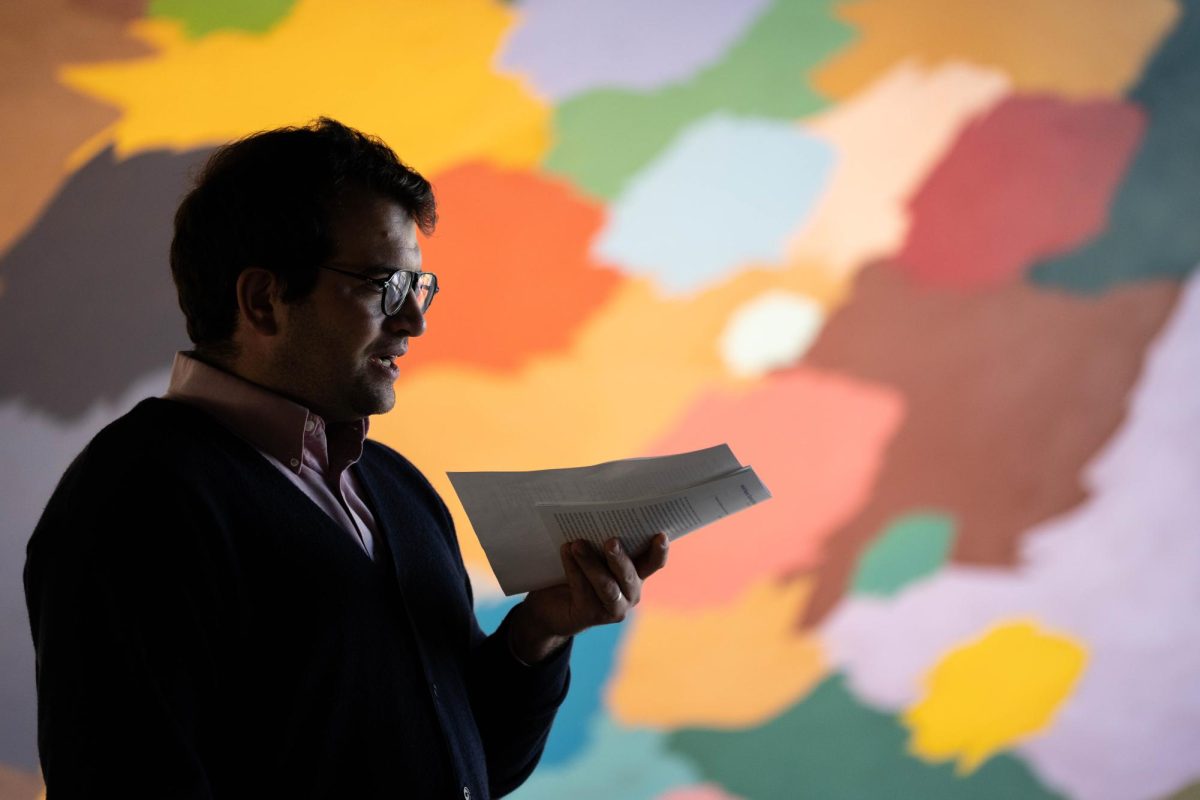
For many WSU students, poetry began as an assignment or a required course. During professor Colin Criss’ Community Perspectives tour, poetry became a lens that helped viewers see abstract art, and even themselves, in a new light.
By selecting poems and pieces to discuss, Criss’ Community Perspectives tour explores pattern, surprise, and artistic intersections between poetry and visual art.
Maia Ottenberg, a first-year entomology student, saw a lionfish in Kapoor’s Mother of Light print. She is an experienced poet with two publications, and had seen the exhibit before, but was able to experience the piece in a more deep, abstract way.
“You’re not limited to be like ‘oh, this is a blob,’ or ‘this is color,’ or ‘this is ombre’; you’re allowed to look beneath and warp them to fit how you see them,” Ottenberg said.
Fellow attendee Lauren Kwartin, a third-year English education major, looks forward to implementing the interdisciplinary discussions of art and poetry in the future.
“I took Colin Criss’ honors poetry class, and it was really exciting. It was my first deep dive into poetry; it definitely drove me to want to integrate it into my future curriculum,” Kwartin said.
Many of the attendees were, ultimately, Criss’ students who had learned to love poetry through his course, stories similar to Criss’ own start in poetry.
“I was not into it at all. I never seriously read a poem until college,” Criss said. “It totally changed my life. Just that course, it was for a requirement, it totally changed what my priorities were academically and personally for the rest of my life.”
Poetry, as a medium, is unique in its lyricism and pattern. These qualities are shared between visual art and poetry, a connection that Criss fixated on as a way to understand both forms of artistic expression.
Criss said, “In terms of the more important or more notable intersections, I think visual art and poetry take on a lot of the same concerns that an artist has. Namely of representation and of how form can approach subject matter.”
Considering the abstraction of all works on display at the museum, supplementing viewership of the pieces opens up new avenues through which to observe the artwork.
“I had seen the exhibit before, I definitely liked it better this time,” Ottenberg said.
Kwartin was a first-time visitor to the exhibition, but is looking forward to revisiting the exhibit with a different perspective.
“Even from [the atrium], it caught my eye, and going into the exhibit makes me really excited to come back and see the rest of it,” Kwartin said.
Perspective is an important external factor to art consumption and viewership. Viewers assume either their individual point of view and make interpretations, or they take on the artist’s point of view through the intention and interpret the piece in the context of the artist.
“When I walk into a museum, the thing that is top of mind for me is my perspective. Implicitly, I am prioritizing that over the artist’s perspective because I’m trying to understand it in the context that I’m approaching the piece from,” Criss said.
Criss believes that both an individual’s and an empathetic artist’s interpretation are valid and take on new life when held against an external piece like a poem.
“I think we’re always, to some extent, misinterpreting visual art or poetry, always, you know, without a doubt, because to assume that anything can be properly interpreted means that there is a hidden interpretation from us.” By further contextualizing art and poetry through each other, we can approach a more whole, not necessarily correct, interpretation, Criss said
Kristen Becker, Director of Education at the Jordan Schnitzer Museum of Art, contributed her perspective as a visual artist alongside Criss’ written artist interpretation.
“Poems, writing, these are art forms that exist in time; the existence of poems is illusive, I want to hold on to it all at once and I can’t,” said Becker.
When looking at an artwork, the broad stroke of the visual image can be interpreted by the brain all at once. By the nature of language and writing, a passage cannot exist for us all at once.
Criss said, “The poem language still does exist in time, right? We’re tempted to remove the poem from time by putting it with a work of visual art, we can approach holding the poem together, across its corners.”
The poems that Criss selected to bring into focus with the art were not obviously connected to the art; rather, they were loosely associated with the visual and language patterns between them.
“I was tempted to really just pick like four of my favorite poems and four of my favorite works and kind of mash them together randomly and see what the tour kind of started to think about the contact points were,” Criss said.
Working against this inclination, Criss’ strategic selection of compatible works invited open dialogue between attendees.
“Thinking about the exhibit in conversation with the poetry definitely encouraged me to look longer and more in-depth at some of the pieces that I would’ve glanced over,” Kwartin said.
By reading poetry against visual art, Criss, Becker and the student attendees approached vastly different interpretations, but retained a shared visual and poetic experience.
“Visual art and poetry, they’re very similar ways that people make those two things and think about making those two things,” Criss said.
Criss’ poem and art pairings are listed below.
- Neuf Series by Hock E Aye Vi Edgar Heap of Birds, ‘Color Outside the Lines’, paired with Prayer by Jorie Graham.
- Mother of Light by Anish Kapoor, ‘Dissolving Margins’, paired with Starry Night by Laura Newbern,
- Hex Mirror by Anish Kapoor, ‘Dissolving Margins’, paired with Monet’s Waterlilies by Robert Hayden.
Anish Kapoor’s ‘Dissolving Margins’ and the Jordan D. Schnitzer and His Family Foundation Collection exhibition ‘Color Outside the Lines’ will be on display at the Jordan Schnitzer Museum of Art until March 14, 2026.