

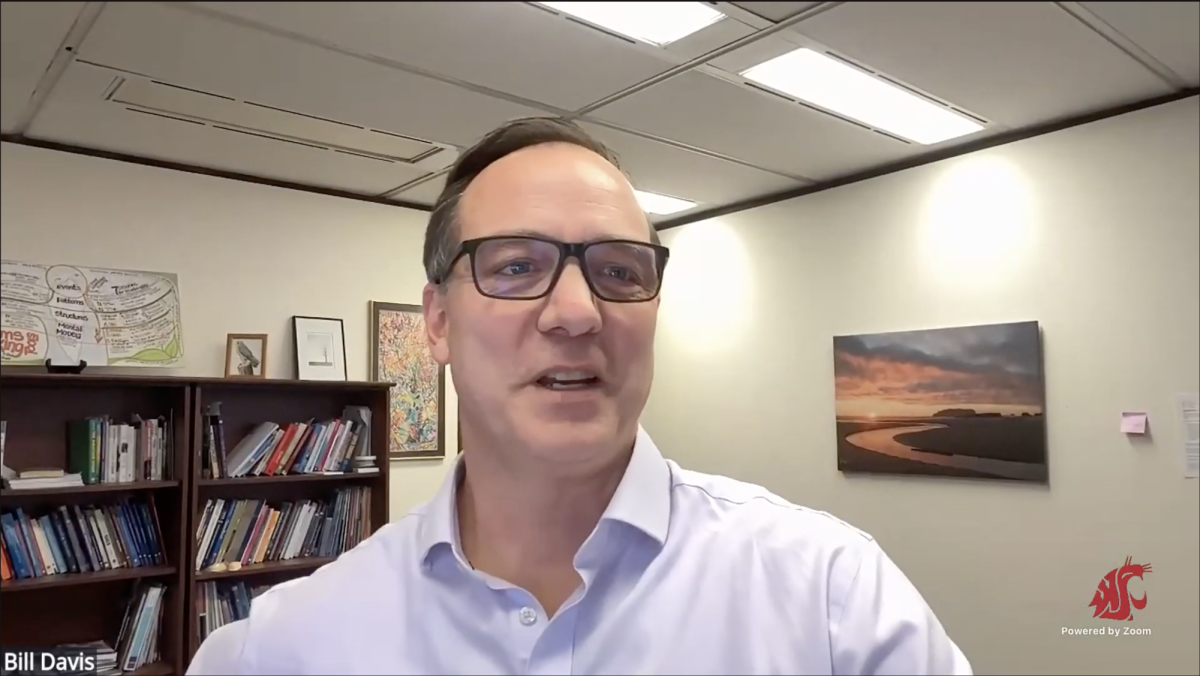
Bill Davis, vice provost for academic engagement and student achievement, introduced new plans for three-year bachelor’s degree programs during Thursday’s WSU Faculty Senate meeting. These programs would be offered alongside standard 120-credit programs, not as replacements or accelerated options.
The standard 120-credit bachelor’s degree dates back to the 1900s, Davis said.
“The 120-credit bachelor’s, which is what we have all known as the standard in terms of semester credits, goes all the way back to the early 1900s and the Carnegie Foundation,” he said. “The Carnegie Foundation for the Advancement of Teaching established what was called the Carnegie Unit, which was a fixed amount of time for students to be in seats in the K-12 system for one unit of education.”
Though the Carnegie Unit for fixed hour requirements was originally developed for the K-12 system, higher education quickly adopted the same standard.
“What this was intended to do was to standardize K-12 education…but it had a knock on effect in colleges and universities,” Davis said. “At some point, institutions like WSU elected to adopt the Carnegie Unit for admissions of students…in 1910, the Carnegie Foundation came back and they set the standard that a bachelor’s degree must consist of a minimum of four years of study.”
This standard was eventually codified by regional accreditors and developed into the 120-credit system normalized today, Davis said.
During an ask and answer period at the end of the presentation, faculty asked why the university is only now looking at shorter programs.
“Why are they now finally realizing they can offer degree programs for a lot less time and money?” asked Dene Grigar, professor and director of creative media and digital culture.
Davis put it on regional accreditors, saying universities were never allowed to implement shorter programs until now.
“Starting this last summer, NWCCU ended a pilot study that it was doing, and what it did was it opened up for all of the institutions that can offer bachelor’s degrees within its accreditation space the opportunity to offer what they’re calling three-year bachelor’s,” he said.
During the presentation, Davis explained what the 90-credit bachelor’s degree structure would and would not look like for students.
“A 90-credit bachelor’s is a bachelor’s degree, and for all intensive purposes, it functions very similarly to a bachelor of science [and] a bachelor of arts,” he said. “It is eligible for federal financial aid, the same as any other bachelor’s degree.”
The 90-credit structure would not be an associate’s degree, nor would it be any less rigorous, Davis said. These three-year programs would have to go through the same approval and accreditation process as any of the four-year, 120-credit programs.
“It’s also a degree that’s going to have to follow the exact same approval process as any other bachelor’s degree that we offer at WSU,” he said. “It would have to go through Provost review, Faculty Senate review, [and] be approved by the Board of Regents, and then it would have to undergo NWCCU review.”
Offering 90-credit programs may have several benefits for the university, university partners and students, Davis said.
“Offering 90-credits bachelor’s is really aligned with WSU’s land grant mission to provide a high quality education to the people of Washington State,” he said. “What we know is that there are industries or other groups that come to us and they tell us that there are careers that could be better served in their opinion by a shorter duration bachelor’s degree.”
In addition to potentially offering greater flexibility and higher quality curriculum, these 90-credit degrees may also help slow WSU’s declining enrollment.
“[These programs may] allow students to leave with lower student debt [and] lead to higher competition in the educational market place,” he said. “The 90-credits bachelor’s may provide WSU new avenues to attract previously enrolled students with some credit [but] no degree.”
During the ask and answer period, faculty also questioned the impact shorter degree programs might have on existing programs.
“Why would a student take a 120-credit bachelor’s if the 90-credit is available?” asked Dr. Alan Goodman, associate professor in the College of Veterinary Medicine.
Davis said a program would ideally make a decision to offer either a 90 or a 120-credit pathway, not both.
“Since the number of credits for upper division [courses] for 120 versus 90 are the same, how is this going to impact lower division courses?” asked Darrell Jackson, associate professor of pharmaceutical sciences.
Davis admitted the impact remains unclear, though he said it likely depends on how many 90-credit programs are offered. He also said many lower division classes are electives students enroll in to complete the 120-credit requirement.
Dr. Philip Bates, associate professor at the Institute of Biological Chemistry, defended electives, pointing out electives have been used to provide a more rounded education and to allow students to explore different topics.
In response, Davis said students are able to explore topics in other places, like during general education requirements. He also said programs would need to think about their curriculum and figure out what is necessary, and if some electives are determined to be necessary, then programs would still be free to work them into their curriculum.
The Daily Evergreen reached out to the University of Washington, the state’s largest and oldest university, to check in on their plans. At this time, UW has no plans to offer a three-year bachelor’s degree, said Victor Balta, a spokesperson for the university.