

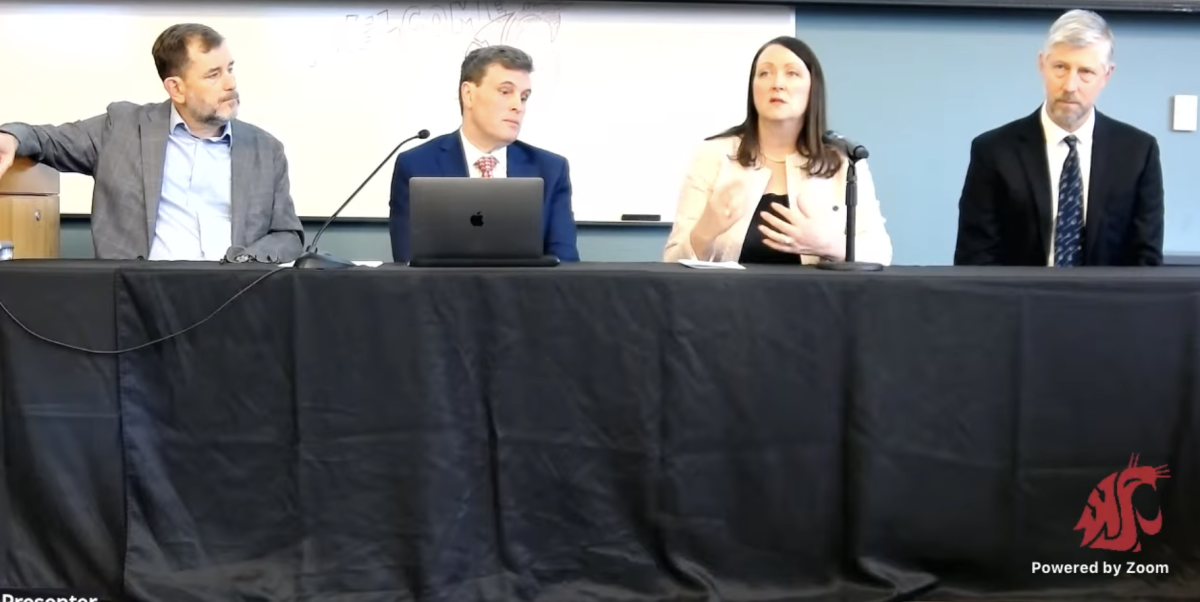
WSU’s Board of Regents met Thursday to discuss a multitude of issues that could alter tuition costs, athletic funding and academic offers, such as major options. This development came due to the tightening state budget, according to references made by the Regents.
One of the discussion topics affecting WSU students came during the review of the cost of tuition and fees for the 2026-27 academic year. The Board’s Chief Financial Officer, Leslie Burnelli, told the Regents a large number of professional and graduate programs were slated for another 3.3% increase, aligning with the state’s tuition cap.
We know that the inflation inside of higher ed is at minimum 3.6% and we are held for the undergrad and grads at 3.3%,” Burnelli said during the meeting. “We are looking to increase these rates simply to cover inflationary costs.”
Student-led advisory boards covering dining, campus services and housing proposed an increase to the costs of residence halls rates, meal plans and campus facilities, according to a presentation during the meeting.
The officials told the Regents the lowest rate for residence halls would be rising by 4.5%, with a 3.5% increase for on-campus apartments. Meal plans are also expected to rise in cost, with the lowest plan increasing by 3.9%, the mid-level plan increasing by 3.9% and the largest plan seeing a 4.3% cost increase.
“Our overall average increase for a student when housed in a traditional double room, eating a level two meal plan will be about 5.2%,” said Romando Nash, vice provost of student affairs. “These fee increases are really focused on increased amenities, the need for improvements to the facilities throughout the housing and dining center and really looking at estimated increases in operational costs. I will remind you all that, as an auxiliary enterprise, housing and dining is not subsidized by the students’ tuition. These are user fees.”
These changes come as Gov. Bob Ferguson’s proposed budget for the 2026-27 fiscal year includes a 3.4% cut to funding for WSU and UW.
Glynda Becker Fenter, vice president for external affairs and government relations, warned the rising rate of state insurance and liability premiums could deepen the financial effects.
“3.4% is the minimum under the governor’s budget that WSU could see cut. It could be up to around seven…because there are some issues with the state insurance liability premiums,” Fenter said. “Right now, WSU pays into those premiums, and the increase in those premiums proposed by the governor’s proposal could be an increase of 4 to 500%. We would be responsible for paying that back payment with the governor’s proposal that is based on tuition revenue that we don’t have.”
In part, due to budget issues, the Regents also came closer to finalizing a decision on program cuts to WSU Tri-Cities. Campus Chancellor Sandra Haynes told the Board there would be a scheduled vote for the termination of bachelors of art degrees in both fine arts and hospitality business management.
“I’ve reported to this Board before on the academic portfolio and resource review that we did over a couple years at the Tri Cities, and it is still an ongoing annual event that we review this kind of data,” Haynes said. “That first review did reveal that there are two programs that had very low enrollment, and we decided that the best course of action was to close those programs.”
Name, image and likeness (NIL) affairs were also a topic of the meeting, with Interim Athletic Director Jon Haarlow giving a presentation that defined NIL as the future of WSU Athletics.
“NIL, it’s become the single most important ingredient in the recipe for success in our revenue,” Haarlow said. “Isolation, culture and tactics only looks pretty on practice days. Culture and tactics don’t win games without talent. You have to have all three to give yourself an opportunity to be competitive. The gateway to recruit and retain talent is through NIL, plain and simple…this is a new reality of college athletics.”
According to Haarlow, the future of the Pac-12 Conference could mean averaging millions annually through NIL and revenue sharing. He also said WSU aims to remain competitive with NIL.
“We’re seeing in real time the impact of NIL investments when paired with the right staff, structure and vision,” Haarlow said. “It’s possible to win in the new NCAA at Washington State University.”