

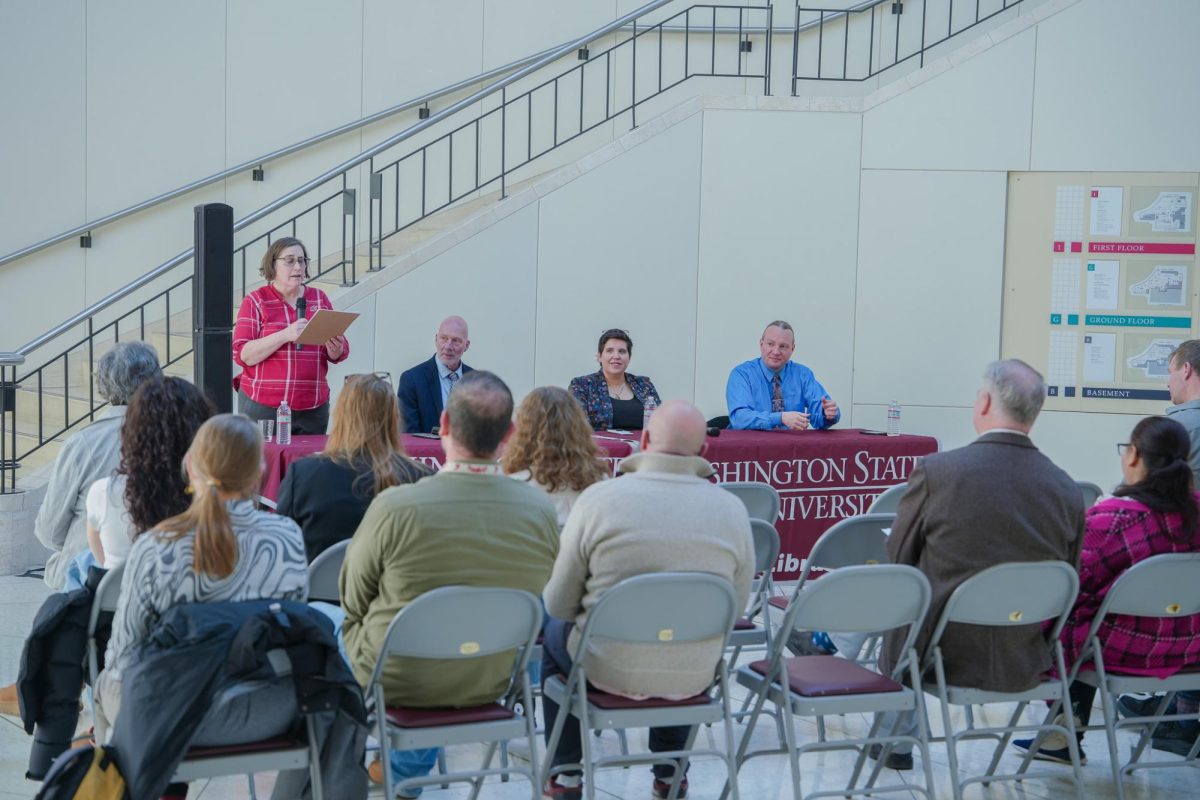
The 13th annual Crimson Reads event hosted by the library March 26. The three panelists were a multidisciplinary trio who shared their experiences writing and publishing books for both educational and public audiences in the past year.
The panelists included Dr. Samantha Noll, a professor of agricultural and food ethics, Dr. Nikolaus Leo Overtoom, a professor of ancient history, and Dr. M. Grant Norton, the Dean of the Honors College and material science professor.
Although their books could be used for education, each author articulated they wanted their books to be approachable to a general audience as well.
Overtoom described his newly published book, “The Parthians at War,” as a cultural reflection on the Ancient Greeks’ first-hand accounts as perhaps unreliable narrations. Overtoom’s goal was to decenter the Greeks by bringing in the perspectives of often-overlooked people of West Asia and asking how the Ancient Greeks interacted with their neighbors.
Noll said she wants her book, “Ethical Omnivorism,” to be approachable, where people could sink their teeth into the philosophy of food.
“We practice food ethics every day,” Noll said.
She wanted the book to reflect that. Each chapter begins with a vignette, and then becomes more specific. Her challenge was to navigate the thin line between approachable and academically rigorous.
Norton said he was specifically trying not to write a textbook when he wrote “Ten Materials That Shaped Our World,” as he had already written successful textbooks and wanted to write something for a general audience.
When asked about advice to start writing a book, Norton said one should look for an avenue for their book and reflect on whether or not something like it has been done before. If it has been done before, he suggests finding a unique angle.
Noll advised aspiring writers to pick something you are passionate about and boil down the book into a paragraph. Once you have the paragraph, she said, talk with family and friends about it to see what excites them.
Overtoom said that the way to avoid burnout is to write something every day and the process requires budgeting time to maintain work-life balance.
The library staff member who emceed the event asked them what part of researching and writing for their book was most valuable.
Overtoom said he made the mistake of writing two books simultaneously. However, he appreciated being able to use the research for both books. Thematically, Overtoom found himself appreciating and growing as a scholar by researching aspects of historical conflict like logistical necessities, infrastructure and food consumption that have not previously been his focus.
Noll took an approach similar to a dissertation in which her hypothesis or central theme was separated into subquestions and each subquestion is answered by a chapter. Noll said she was exploring with the reader as she took the journey through the book and navigated themes of our dominant consumerist culture.
Norton said he wanted to create a new kind of history within material science and used students as a sounding board for what made sense to include or focus on. He examined a hundred-year history from 1920 to 2020, beginning with the first instance of a metallurgist winning a Nobel Prize.
Support from family, peers and publishers was key for all three and they highlighted the importance of relationship building in the industry.