


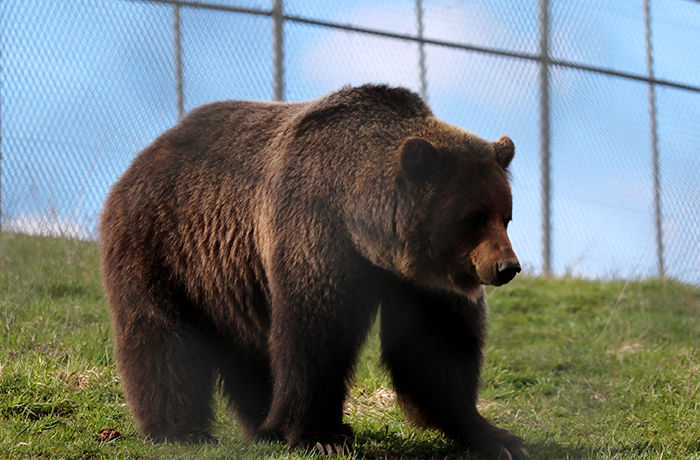
WSU’s grizzly bears at the Bear Research facility are being used to help test camping equipment to gauge how “bear-proof” it is. Equipment is never 100% bear proof, but “bear-resistant” is the proper term often applied to equipment that is deemed to be safe for campers in bear territory.
The WSU Bear Research, Education and Conservation Center first opened in 1986. It was first created due to a need to study grizzly bears in captivity. The center features 2.2 acres for the bears to roam, along with outdoor dens and several outdoor runs. According to the official website, much of the work done at the center focuses on reproduction, behavior, ecology, nutrition, physiology, as well as learning and memory.
Along with the bears in captivity, graduate students involved in the bear center work with grizzlies out in the wild. By doing this, we are developing a better understanding of bear biology and ecology as well as improving conservation efforts.
According to Pullman Radio, WSU’s grizzlies have been testing food containers for companies since 2022. These companies are hoping to earn their spot on the Bear Resistant Products List.
The Bear Resistant Products List is the official inventory of products that have undergone testing with live bears to confirm they can withstand wild bears’ attempts at opening and obtaining food and garbage. This prevents bears from becoming food-conditioned and moving themselves closer to humans, thus leading to more bear-related incidents.
This list is managed and certified by the Interagency Grizzly Bear Committee (IGBC), which is an organization of agencies that manage, research, and handle conservation efforts on grizzly bear populations in the western United States.
For bear products to earn a bear-resistant rating, the product must withstand about 60 minutes of a bear actively trying to break into it.
Tests over the years have shown that containers that screw together and have snaps to hold them in place and those that are typically a cylindrical shape, take longer for bears to break into than a typical cooler.
Chelsea Davis has been working at the WSU Bear Center for four years now. Over the years, she has enjoyed getting to know the bears individually and their personalities. Along with getting to know the bears, Davis highlights how much she has learned about the core focuses of the center.
“When I first arrived, I thought nutrition was all the center did. Since I have been here, we have done so much more. We’ve done energetics, genetics, physiology, so many interesting things with hibernation, cognitive/behavioral, ecology; the list never seems to end. The amount of collaboration, as well, has been eye-opening. Every day I learn something new”, Davis said.
When a product is tested, something is often placed within it to grab the bear’s attention so they will want to see what is in it. Davis discusses her method when testing out products.
“I use the something smelly, something noisy, and something oozy rule when trying to motivate the bears. So smelly is easy, our bears really like sausage or cheese. We have done canned fish, but not nearly as popular with our bears as sausage. Noisy might sound weird, but when the bears start moving the test items around, I want them to hear that there is something inside. A sausage doesn’t make much noise, but a few dog biscuits or an apple will. The noise helps keep them motivated,” She said. “The items we test don’t have to be leak-proof, so that’s where ‘oozy’ comes in. Honey water, juice, yogurt, and even ice cream work perfectly for this. As the bears work, a small amount will leak out, giving them a taste of what is in the cooler. It’s a small reward to keep working.”
Davis acknowledges that when testing a product, each bear has a different technique to open it.
“We have one bear, Kio, who can open her way into any cooler that has thin plastic walls. We have a younger bear named Zuri who likes to toss things against walls. Luna likes to do CPR and smash things. It’s fun to see their different personalities that come out in their techniques. You will notice that those are all female bears. Our male bears are ok at testing, but if it takes more than 5 minutes to break into something, they tend to walk away from it,” Davis said.
According to WSU Insider, the center allows products like this to be tested on their grizzlies to protect their wild cousins. These products make sure there is less bear-human interaction, leading to less conflict between wild bears and humans.
These tests are also great enrichment for the bears. They help keep their minds sharp and work on their problem-solving skills.
The bears are just now waking up from hibernation and from now through summer, they will be put to the test on containers that are meant to keep them out.