


Before the first shipments leave each morning, and before thousands of baked goods begin their journey down various factory lines, baker Kao Sieu Luc is already up at work.
For Luc, baking has never been just a profession or a passion…for him, it was a means of survival.
In 1975, Cambodia fell under the control of the Khmer Rouge, the radical communist regime led by Pol Pot. Over the next four years, nearly two million people died from execution, starvation, and forced labor, according to a BBC report.
Luc was among the many young people forced into the camps in his youth with his whole family. Luc recalled losing his father and brother to the camps. When he had the opportunity, he fled into the jungle with his mother and sister.
With them, Luc walked for around a month, crossing into Vietnam on foot, with nothing to his name and no understanding of the Vietnamese language. The only thing Luc said he had when he arrived in Vietnam was the all-encompassing urgency to survive.
“He comes from the killing fields… with nothing,” his friend and interpreter for our interview, Francis Lee, said. “He needed to survive. That’s why every challenge now is not a challenge to him.”
The mindset of working to survive and sustain his family still defines the way Luc works in the present day.
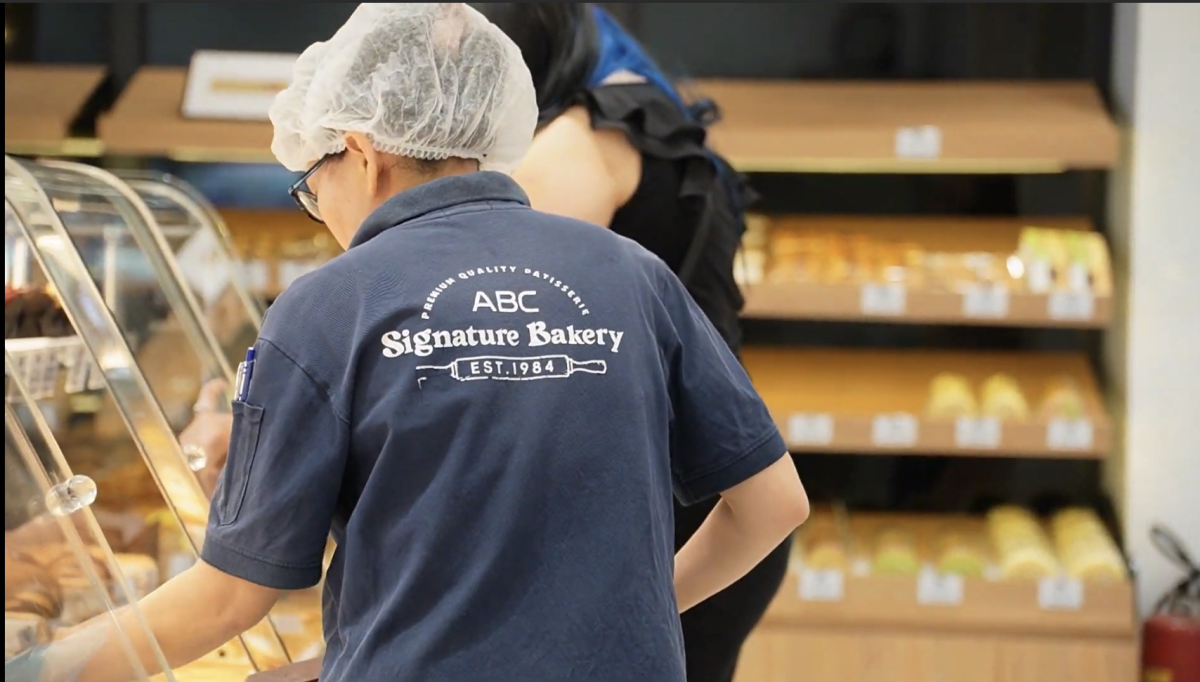
Inside ABC Bakery in Ho Chi Minh City, a desire for survival has transformed into success on a global scale. What started as Luc teaching himself to bake and opening a small operation has now grown into a highly coordinated production system, supplying baked goods to chain restaurants and grocery stores across one of the largest cities in Southeast Asia.
Hundreds of hamburger buns are moving in synchronized batches down conveyor belt lines. Each step of the process is calculated for consistency and time efficiency.
ABC’s bakery has become a major supplier for companies like McDonald’s and KFC throughout the city, producing goods at a volume that reflects its precision and dedication to improvement in the industry.
His philosophy when it comes to the continued expansion of his business and the innovation of new baked goods remains as simple as it was when he started: keep improving or fall behind in an ever-growing industry.
“Like today, if you don’t come up with new things, improve new things, you will be obsolete,” Francis said to Luc. “You will be out of the competition.”
Luc’s principle is embedded into every level of ABC Bakery’s production. Innovative uses of machinery are not just used for scale, but for refinement of the baking process. The flow of machine and man in tandem is constantly evolving to better the baking process. Each movement, either machine, man, or both, is improved daily to increase output and improve quality.
Here at ABC, innovation is not optional; it’s required, and deeply operational.
Increasingly, that innovation is reaching beyond just Vietnam.
In addition to shipping goods to countries like Japan and France, ABC Bakery is also on track to make an impact thousands of miles away in Washington State.
Here, a familiar apple, the Cosmic Crisp, was developed through decades of research at Washington State University and commercially released in 2019. While the apple has become a staple in the U.S., particularly in the PNW, it’s still gaining traction in Vietnam.
For Luc, that presents a unique opportunity to produce something new.
Even at the scale of his current factories, he continues to experiment with new goods, testing new ingredients. Luc enjoys evaluating how different goods could be utilized to perform in the different products he makes. According to him, Luc is always looking for the best ways to maximize both efficiency and value in his business.
“The skin can be used for fermentation… for sourdough,” Lee explained. “The inside can be used for pie. Every part must have value.”
Luc’s early experimentation with the apples has already revealed promising results.
“The skin from the Cosmic Crisp has better aroma… better for fermentation.”
For now, no Cosmic Crisp products are moving down ABC Bakery’s production lines. But that development, for Luc, is part of the process. Test, refine, then once he’s confident in the product, scale up.
This is the same disciplined approach to building up that allowed Luc to scale his company from nothing.
Because in this system that Luc has created, falling behind, feeling defeated ever again, is not an option.
“Any challenge is not similar to what he came from…from the killing fields,” Lee said.
Despite the size of the operation, Luc’s leadership style also remains personal. Workers are treated like family in his company…a reflection of the suffering he endured and the resilience he built following tragedy.
“He understands suffering,” Lee said. “That’s why he treats workers like family.”
What began as a story of survival has become something much larger and representative of perseverance. A business that provides for one of the world’s busiest cities, connects global supply chains and now, in a minor but meaningful way, is linking its home of Vietnam back to Washington State.
Inside one of Luc’s many factories, machines continue their steady, grinding rhythm. Trays land stacked, lines of products move. Production is day in and day out, a well-oiled machine.
Even after building a baking empire from absolutely nothing, Luc still says he finds purpose in experimenting. He’s always refining, always analyzing what product breakthrough might come next.
For Kao Sieu Luc, survival is not just a part of his story or something he endured. It is the foundation of his personal system and the force that continues to drive him forward.