



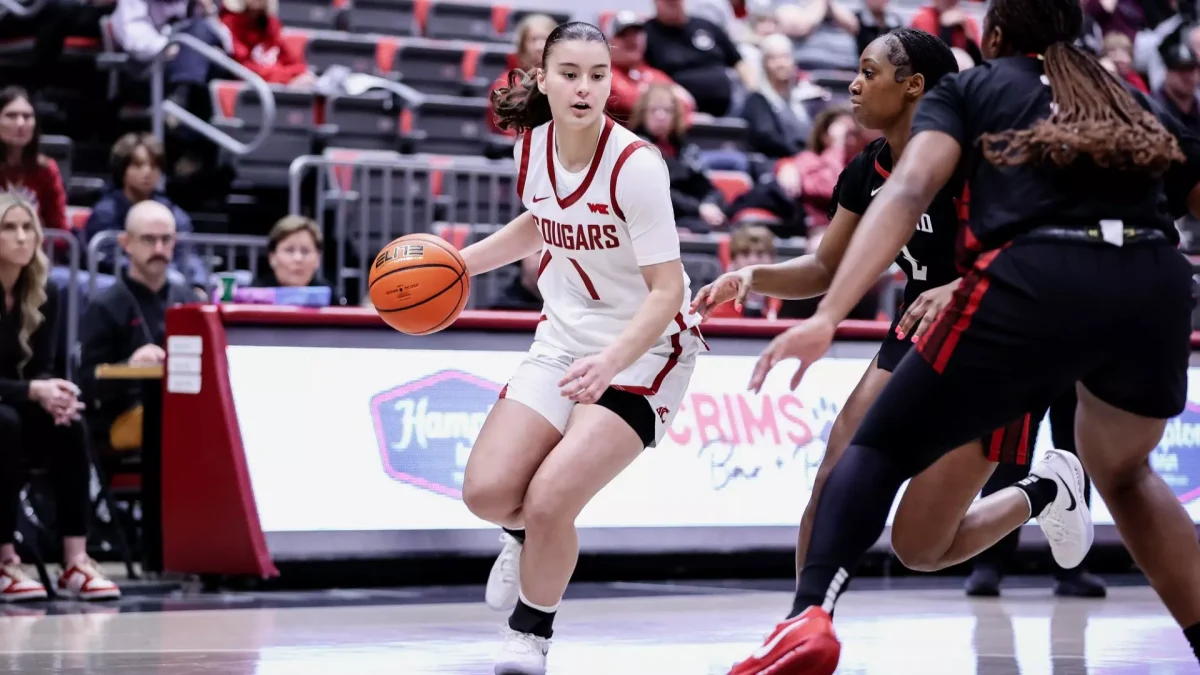
Most NCAA athletes do not suit up for their respective schools until they are 18 years old, 17 if they are lucky. Malvina Haziri was just 16 years old when she made her debut for Washington State University in late November.
Haziri’s hometown is from Vushteria, Kosovo, a nearly 19-hour flight from Pullman, Washington. Despite the distance Haziri feels like she is at home. She loves Kosovo, but feels like Pullman is a complete 180 from her hometown.
“In America, people smile at you and ask how your day is going,” Haziri said. “Back home, it’s more distant. Here, you feel like people are there for you.”
Unlike many of her teammates who followed a more traditional path to college basketball, Haziri developed her game overseas by playing against older competition at a young age. That experience helped accelerate her growth and prepared her for the physical demands of the college level.
“You kind of evolve early,” Haziri said. “You play with older players all the time, and that actually helps in the long run.”
Haziri said the biggest difference between European and American basketball is the pace and physicality. She noted that the American game is faster and more aggressive, while European basketball focuses more on fundamentals and structure. She also emphasized how systems vary more from team to team in the United States.
“In college, every team has a different system,” Haziri said. “Some play faster, some focus on shooting, some on defense or post play.”
Adjusting to life in America was a big transition for Haziri, especially being so far from home at a young age. She said the people in Pullman made the transition easier because of how welcoming and supportive they were, helping her feel comfortable in a new environment.
“You’ve got to show up every day, hold people accountable and be disciplined,” Haziri said. “That’s one of the biggest changes for me.”
Outside of basketball, Haziri has found joy in the simple moments of life in Pullman. Whether it is spending time with teammates or whatever else Pullman has to offer.
“We try to make joy out of little things,” Haziri said. “Watching sunsets, going to coffee shops, just being together.”
Haziri described her first season at Washington State as a learning experience. Being the youngest player on the team, she focused on adjusting to the level of competition and improving every day rather than setting strict expectations for herself.
“I just focused day by day. Everything was an opportunity to learn,” Haziri said.
Reflecting on her journey, Haziri said she would tell her younger self to trust the process and stay confident, even during difficult moments. She emphasized the importance of staying true to herself throughout the transition.
Looking ahead, Haziri wants to continue developing her game and take on a bigger role for the team. With a better understanding of the system and her surroundings, she is focused on growth both on and off the court.
“I’m really excited for next year,” Haziri said. “Now I understand the system better, and I just want to keep getting better.”
For Haziri, the journey from Kosovo to Pullman has been about more than basketball. It has been about growth, adjustment and finding comfort in a new environment.
“I think the people make the place,” Haziri said.